
Being There
A Gardener, a President, and a Pond

I have carried one movie inside me for most of my life.
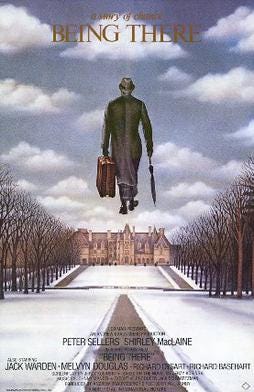
Not in the “quote it at dinner parties” way. More like a small internal compass that’s been quietly shaping how I see people for most of my life.
The film is Being There.
Peter Sellers. Subtle humor. Almost no action. Long pauses, and a strange, gentle current moving underneath everything. Many people today would watch it and shrug. It’s not paced for us. It doesn’t shout or chase your attention or deliver its meaning in bright, clean sentences. It asks you to sit still long enough to notice what’s happening inside you while you watch.
That’s exactly why it mattered to me.
I saw it young. Too young, probably, to “get it” in any academic sense. And like a lot of things that hit us early, I didn’t understand what I understood. I only knew that it landed. I’m older now, and I think I can finally name what it did: it introduced me to projection before I had the word projection.
The story, on the surface, is almost absurd in its simplicity. A man who has lived a sheltered life as a gardener is suddenly placed into the world of power, money, and influence, and people begin to interpret him as wise. But the real plot isn’t what happens to him. The real plot is what happens to everyone around him.
A simple man speaks plainly, and the people around him translate his simplicity into brilliance. They turn him into what they need him to be. They fill him with meaning he never claimed, and they hear what they were already primed to hear. That’s what has always fascinated me—how much of what we think we’re perceiving is actually our own mind speaking back to us.
We rarely listen to people. We listen to our story about people. We listen to our biases, our hopes, our fears, our hunger for certainty, our need for someone to reassure us that the world makes sense.
The man at the center doesn’t deceive anyone. He doesn’t manipulate or perform. He simply exists, and the world does the rest.
There is something almost unbearable about that once you see it, because it means we’re doing it all the time. We take a few data points and we build a person. Then, without realizing it, we interact with the person we built instead of the one in front of us.
I know exactly when I learned I do this. Years ago I decided, within about ninety seconds, that a new coworker was arrogant. Something in the way he held himself. I spent months relating to that version of him. Polite, guarded, faintly cold. It turned out he’d been terrified the entire time, certain everyone in the building was smarter than he was. I hadn’t been reading him at all. I’d been reading a character I cast in a role and then resented for playing it.
The film doesn’t let you stay above it. It tempts you to project as well. You watch him and start asking the same questions the characters ask. Is he innocent? Is he empty, or some kind of accidental saint? And then you catch yourself: wait, am I doing it right now?
That’s what good art does. It doesn’t tell you the lesson. It sets a trap for your mind and then shows you your own footprints.
And of course there’s that final scene. The pond. He walks out toward the water, and the film gives you a moment almost too quiet for what it implies. Is he walking on water, or is it a trick of perspective? A miracle, or one last joke on the audience designed to test how badly we want to turn him into something more than he is? The movie refuses to answer. It just watches you watching.
When I think about why this film lodged in me so early, I think it’s because it handed me one of the most useful questions a person can carry: What am I adding to what I’m seeing? Not what is happening. Not what is true. What am I adding?
So when people tell me they don’t find Being There that interesting, I don’t argue. The point for me was never just entertainment. It’s one of those rare films that doesn’t demand your attention with fireworks.
Some things don’t hit you because they’re exciting. They hit you because they’re true. And sometimes you only understand what you saw the first time when you come back to it years later, carrying enough of your own footprints to finally recognize them on the screen.
I recorded a conversation about it with Bambos for our podcast A Wonderful Chaos, and I share it here.
Hmnnn, I've not seen this, and now I'd like to. Thanks for yourreflective thoughts!
Well said! Brilliant assessment of the wonder in this film!!… it lodged its way in with me too. And for the same reasons.
I’m always surprised by how few people know of this film.
Insider tip to watching it: come to it with as “clean of a slate” as you can muster. Just BE PRESENT as it quietly unfolds. Not curious, not cynical, not trying to relate it to our times, etc etc… and I suspect the meaning for you will come along in layers. (Maybe over time)
Great work Andy! Thanks for reminding me of this important perspective.