
Concentrated Regret
Three men, seven courses, one cheese plate

I had a client visiting Amsterdam this week, and because another friend of ours happened to be in town for the first time in seven years, I thought it would be nice to arrange dinner. A simple dinner. The kind where people eat fish, exchange stories, nod politely at each other’s lives, and return home at a reasonable hour feeling slightly more connected than before.
One of the men is our accountant. He’s the sort of person who is entirely comfortable in his own skin, including the small but respectable belly that suggests a healthy relationship with bread and the absence of unnecessary suffering. He has no interest in being impressed. You could serve him soup from a thermos beside a motorway and he would simply say, “Very nice,” and continue with his evening completely fulfilled.
Because of this, I scheduled the dinner early. Six o’clock. Efficient. Civilized. In my mind, we would be done by seven-thirty.
The restaurant specialized in fish. I hadn’t been there in seven years myself, but I remembered it being pleasant. What I apparently did not remember was that the restaurant no longer served meals so much as it staged a slow-moving conceptual performance about seafood scarcity.
The waiter handed us the menu, and I immediately noticed something unsettling.
There was no à la carte option.
Only a choice between five, six, or seven courses.
This felt less like ordering dinner and more like selecting a subscription package.
Before any actual food appeared, we were served tea. Not normal tea. The pot was metal, hand-forged, and looked as though it had been carried down from a mountainside in Japan by a man who only speaks in whispers. The cups were ceramic. The whole arrangement appeared more expensive than several meals I’d eaten that month.
The tea was infused with seaweed.
And it was at that exact moment I knew we were in trouble.
Because seaweed tea is not the opening act of a quick fish dinner. Seaweed tea is a warning flare. It says: “You are no longer eating for nourishment. You are about to participate in an experience.”
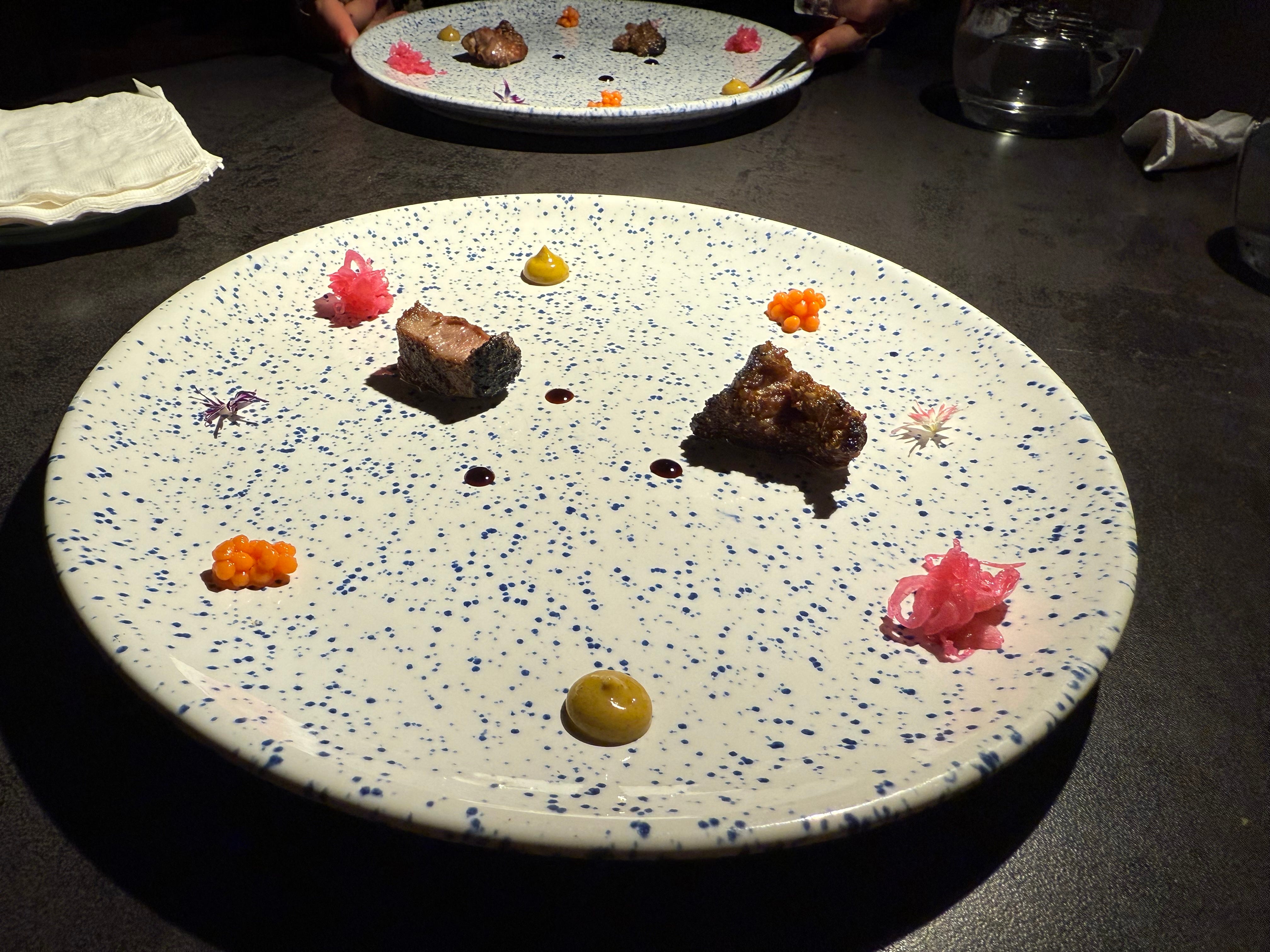
The first course arrived on a plate approximately the size of a satellite dish. In the center sat something that may once have had contact with a shrimp. Around it were three decorative droplets arranged with the seriousness of a museum installation.
We ate it in roughly fourteen seconds.
Then came the second course. A small piece of salmon had been compressed into a shape suggesting regret, accompanied by what the waiter described as a reduction. Less than a teaspoon of it. Whatever it had once been — wine, fennel, the tears of a smaller fish — had been boiled down until only its memory remained.
This, it turned out, was the theme of the evening.
Every course was a reduction of something. You never quite felt you were eating. You were sampling the residue of food. A teaspoon of concentrated essence beside a forkful of carefully arranged protein. By the fourth plate, I began wondering if the chef’s true passion wasn’t cooking at all, but evaporation.
I glanced at the accountant. He was studying his plate with the calm bewilderment of a man who has just been handed a parking ticket in a language he doesn’t speak. He took the half-teaspoon of reduction onto his fork, examined it, ate it, and said, “Very nice.”
The evening stretched onward.
One scallop. One smoked something. One leaf standing vertically for reasons known only to modern gastronomy. Each accompanied by its own carefully evaporated companion.
At some point the meal stopped being something we were eating and became something that was happening to us.
Outside, Amsterdam moved through its evening naturally. Boats crossed canals. People lived entire lives. Somewhere, children were likely conceived and born between courses four and five.
Meanwhile, we remained there, politely chewing microscopic arrangements beneath dim lighting.
And yet, strangely, it became hilarious.
Because once you surrender to the absurdity of something, it transforms. The frustration dissolves and what remains is the story itself. Three men who wanted a quick fish dinner somehow trapped inside a three-and-a-half-hour tasting menu they never knowingly agreed to.
The best course of the evening turned out to be dessert. Not because it was extraordinary, but because it was simple: a cheese plate. Honest. Direct. No reductions. No splattering. Just cheese quietly fulfilling its purpose in life.
The accountant looked at it, nodded once, and ate it like a man who had finally come home.
"...once you surrender to the absurdity of something, it transforms." Brilliant.
I love reading about your life experiences written by you. I smile, I laugh, sometimes tears fall. This one was especially fun. And now I am going to have some uncomplicated cheese.