
Dragon Etiquette
The unspoken rules of standing near something that could easily eat you

For most of my life, Komodo dragons occupied that strange space between myth and reality—creatures filed somewhere between giant squid and unexplored jungle temples. Clearly real, but also safely distant. The sort of thing that exists on remote islands and in nature documentaries narrated by British men with calming voices.
Which is why it never occurred to me that a short flight from Jakarta would eventually place one three meters in front of me.
When I boarded the plane, I wasn’t traveling to see dragons. I was simply trying to leave Jakarta for a few days. As I have written often, the city has a way of pressing down on you—the motorbike exhaust that clings to your shirt, the intersections where nothing moves but everything honks—until the most sensible plan is to open a map and fly toward water.
Labuan Bajo appeared as a small dot surrounded by islands. Boats, beaches, open sea. That felt like enough of a plan.
“Of course,” someone told me over coffee the next morning, “this is where the Komodo dragons are.”
The way they said it made it sound like they were pointing out a bakery.
Naturally, I joined a tour.
We walked along a dusty path that looked strangely Australian for a place that was technically Indonesia—dry scrub, pale dirt, eucalyptus-colored trees standing around like they were waiting for something. Which, as it turns out, isn’t entirely surprising. Long ago these islands were connected to the Australian continental shelf before drifting north, leaving behind creatures that seem slightly out of time. The landscape hadn’t fully caught up with the map.
Then we saw the first dragon.
It was lying in the dirt beside the path, enormous and still, like a lizard that had grown far beyond what any responsible lizard should grow to. Its skin looked thick and armored, its tail muscular, its body heavy with the quiet confidence of something that had never needed to rush anywhere.
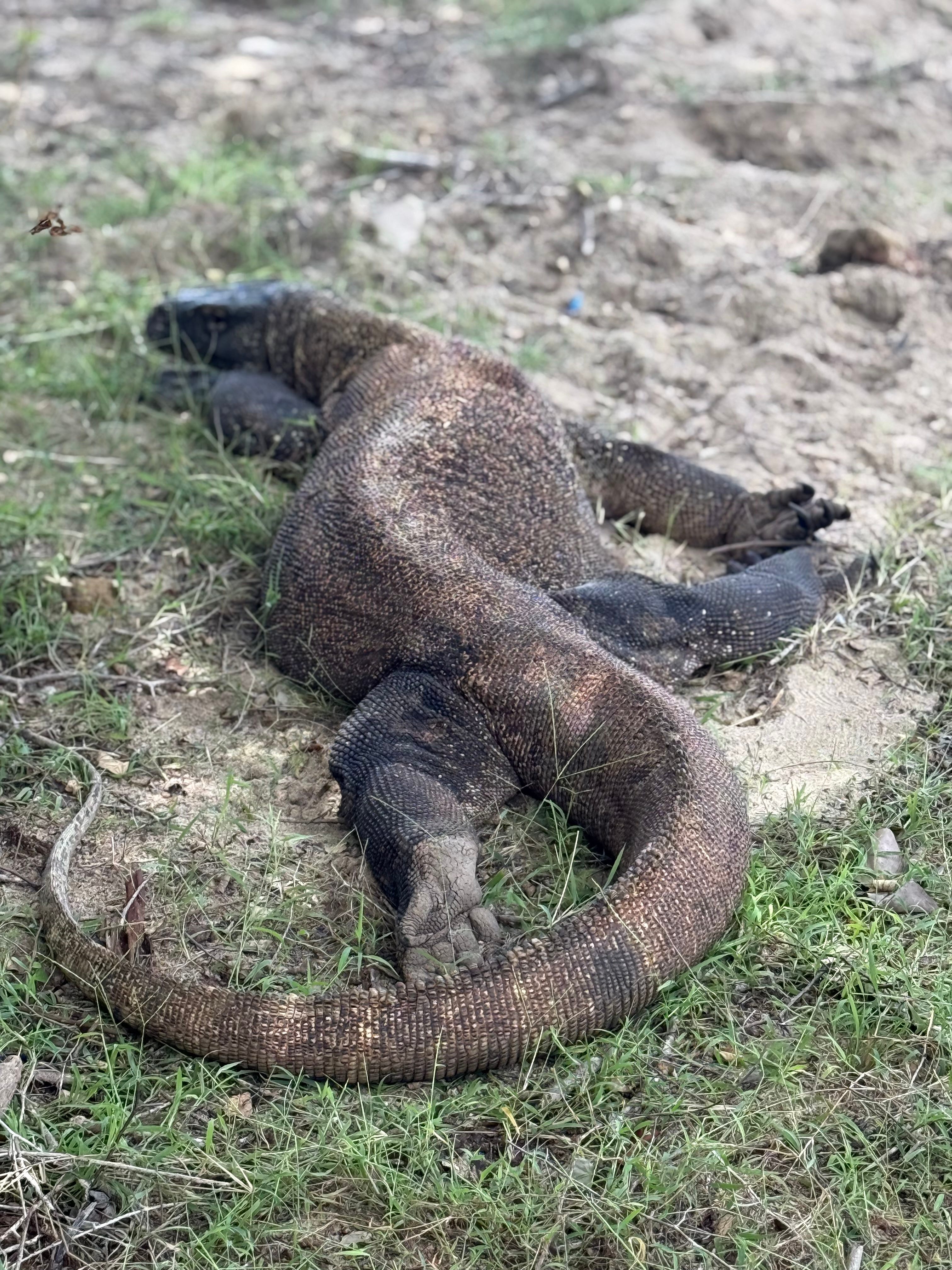
Every few seconds its tongue flicked out.
Split neatly down the middle.
There was something deeply unsettling about that motion. It didn’t feel like watching an animal breathe or blink. It felt like the dragon was quietly sampling the air for information.
At this point our guide walked directly toward it. Not cautiously. Not carefully. Just… toward it. The kind of thing that would generate paperwork in the United States.
Naturally, I followed. Something that has gotten me into enough trouble in my past that Rani has asked me on several occasions to be more thoughtful about who I follow.
When we were standing only a few meters away, it occurred to me that I should probably ask a basic question.
“How fast do they run?”
The guide answered calmly.
“About twenty kilometers per hour.”
This struck me as useful information that might have been helpful earlier, before we had walked to within sprinting distance of the animal.
Twenty kilometers per hour is fast enough that if a Komodo dragon decides it has plans for your leg, your leg will not be negotiating.
The guide then added another piece of advice.
“Stay with the group.”
Which I technically was, although I had drifted toward the back.
Behind me was a small patch of trees I hadn’t paid much attention to.
And inside those trees was another Komodo dragon.
This one was smaller.
Which, as it turns out, means more agile.
Someone behind the guide pointed casually in my direction.
“There’s another one over there.”
I turned and saw it walking toward me with the same deliberate calm as the first. No ranger between me and it.
At some point earlier in the tour we had been told that Komodo dragons carry a tremendous amount of bacteria in their mouths. If they bite you, the infection can become so severe that amputation is sometimes the only solution.
Apparently a tourist had lost a leg this way not too long ago.
Another had died.
This information had been shared with the group in the same relaxed tone people usually reserve for explaining local weather patterns.
And yet there we all were.
Standing quietly.
Taking photos.
Trusting that a man with a stick would somehow mediate the situation if things became complicated.
What struck me most about the dragon was its calmness.
It wasn’t aggressive. It wasn’t threatening. It didn’t seem particularly interested in us at all.
It simply existed.
A creature whose ancestors had walked these islands for millions of years while humans were still experimenting with fire.
Eventually the dragon flicked its tongue once more, turned, and slowly wandered back into the brush.
The guide tapped his stick on the ground and motioned for us to continue down the path.
Within a few minutes the group was already discussing snorkeling, lunch, and which island had the best sunset.
But as we walked away, I kept thinking about the quiet negotiation that had just taken place.
A prehistoric animal had taken one look at me, flicked its tongue, and decided that whatever I was, it wasn’t worth the effort.
It is a strangely humbling experience to realize that after millions of years of evolution, travel, education, and personal growth, you are still not impressive enough to interest a large lizard.
For the rest of the day, the group talked about snorkeling, lunch, and sunsets.
I mostly thought about how close I had come to being described later as
“the tourist that….”
Not by name.
Not by profession.
Not by anything meaningful.
Just a tourist who stood slightly too far from the group.
There is something about standing three meters from a Komodo dragon that rearranges your sense of importance.
You realize very quickly that the world is not divided into people who are brave and people who are afraid.
It is divided into people who are alive…
and people the dragon decided not to bite.
And on that particular morning, for reasons I will never fully understand,
I made the cut.
Which, all things considered, felt like a very fortunate interpretation of the encounter.


Brilliant and funny but very thought provoking! By the way, my friend, that center picture looks like you are a tad closer than the requisite three meters!
"You realize very quickly that the world is not divided into people who are brave and people who are afraid." - I love this! And I'm so glad you got to have this experience. I've been fascinated by Komodo dragons my whole life. Thank you for preparing me for the experience of meeting them some day. I'll make sure to stay with the group!